
A New Pilot Project Opens the Path to Net-Zero by 2030
And to the possibility of restoring preindustrial CO2 levels by 2050

In June of 1991, Mount Pinatubo erupted in the Philippines. The eruption was one of the largest of the 20th century; Pinatubo’s ash cloud circled the globe. Temperatures dropped. And then something happened that took scientists decades to fully understand.
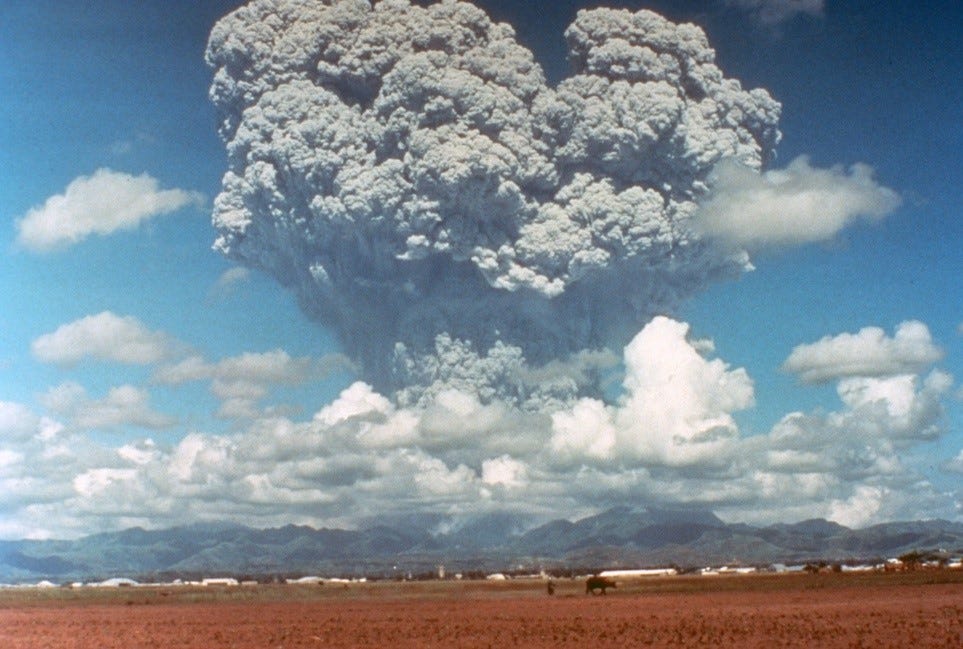
For a brief window in 1992, Earth achieved something we have been struggling toward for decades: net-zero CO2 emissions. Yes, net-zero was achieved for a year. The Keeling Curve, that relentless upward march of atmospheric carbon that has defined our era, went flat. Not thanks to clever policy or technology. But because a volcano, by accident, did something extraordinarily powerful.
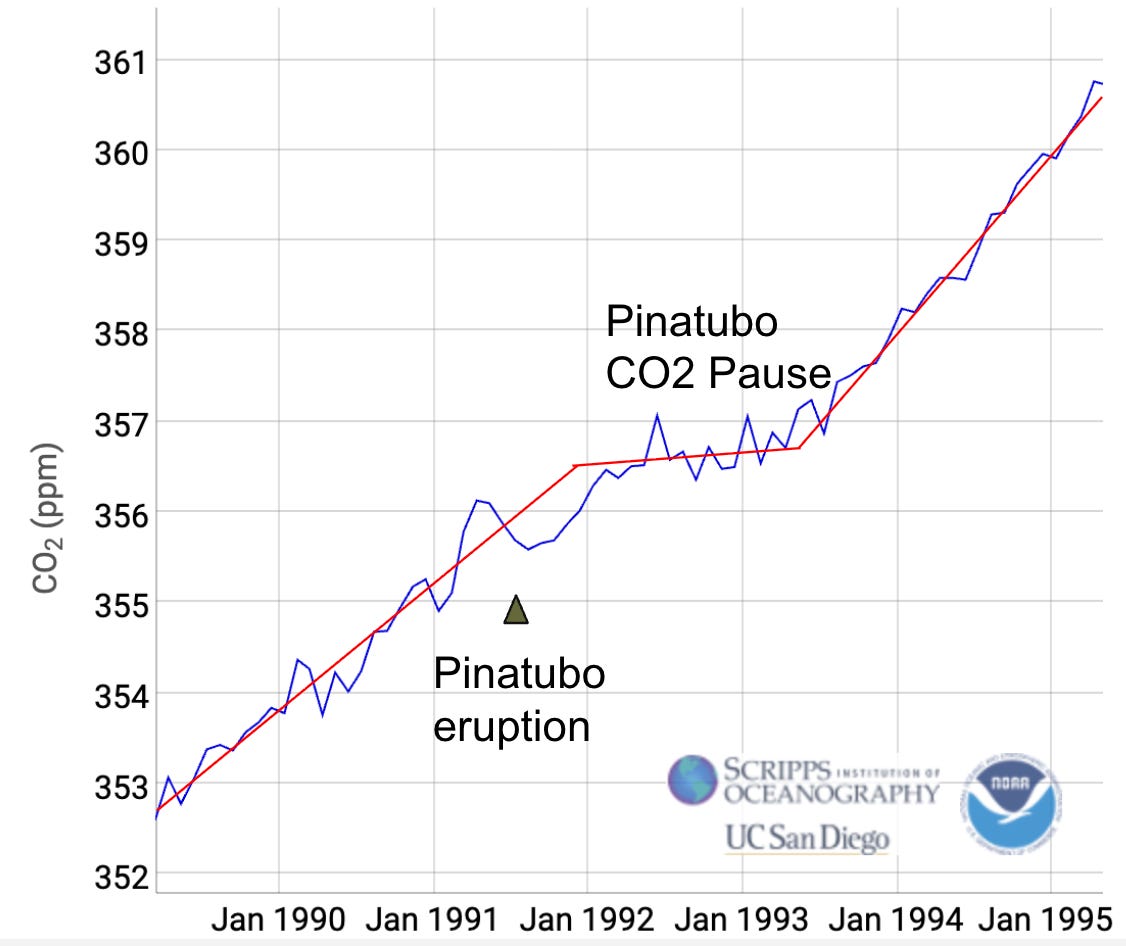
The Keeling curve showing the Pinatubo CO2 pause after the eruption: net-zero for more than a year.
We’ve spent years trying to understand exactly what happened and why. What we found changes everything about how I think we will solve the climate crisis.
The Eddy in the Ocean
Here’s what the data now shows: Pinatubo’s iron-rich ash didn’t fall just anywhere in the ocean. It landed in a specific marine structure: a recurring, 300-kilometer-diameter ocean eddy, or circular current, in the South China Sea. This one is “downwelling,” which means it concentrates, traps, and sinks whatever falls into it. Our preprint article gives more detail.
Iron is the missing nutrient in much of the world’s ocean. Without it, phytoplankton, the microscopic ocean plants that form the base of the marine food chain, cannot photosynthesize. Add iron, and they bloom. Bloom, and they pull CO2 out of the atmosphere at massive scale, converting it into organic matter that eventually sinks and dissolves in the deep ocean.
Pinatubo didn’t save the climate. But it accidentally ran the experiment. And the results were extraordinary.
This wasn’t a one-time fluke. Similar massive CO2 drawdowns followed eruptions in 1580 and 1815. We now have evidence that these events also deposited iron-rich ash into ocean eddies. In the same period, six other large eruptions had no such effect on CO2. Wind patterns show that their ash fell far from eddies.
Then in 2004, a scientific experiment called EIFEX deliberately added iron to a Southern Ocean eddy and documented exactly the kind of CO2 removal the theory would predict.
Nature has shown us the mechanism. Three times by volcano. Once by design. The question is no longer whether this works. The question is how we can replicate it at scale. Deliberately, safely, and verifiably.
The Case for Ocean Iron Fertilization
The math is both humbling and hopeful.
To achieve net-zero emissions by 2030, we need to remove at least 30 gigatons of CO2 per year to compensate for continuing emissions. That sounds impossible. But consider this: the CO2 removals observed after major volcanic events operated at that order of magnitude.
Localized Ocean Fertilization (LOF) is the deliberate replication of this process, but only in ocean eddies. The critical insight is the word localized. We don’t need to fertilize the whole ocean as many fear. We need to identify the right eddies and work within them. Downwelling eddies that concentrate phytoplankton and carry their biocarbon to depth exist in about 1% of the ocean’s surface area.
At that scale, LOF is not just climatically significant. It becomes economically significant. Hundreds of corporations and countries have made public net-zero commitments and collectively budgeted billions of dollars to fulfill those commitments. They need verified carbon credits to do so. A working LOF operation would produce those credits at costs that are potentially far below anything currently available. And at a scale that actually bends the CO2 curve down—benefiting all our children and nature.
The question is no longer whether this works. The question is how we can replicate it at scale.
The Measurement Breakthrough
For 36 years, roughly since the “iron hypothesis” was first proposed, and almost exactly since Pinatubo, ocean iron fertilization has remained stuck at the level of scientific curiosity rather than operational solution. The reason is simple and frustrating: we couldn’t measure it well enough.
To understand and optimize a process, you need feedback. You need to know, quickly and accurately, whether what you did worked. Traditional techniques for measuring oceanic CO2 removal are expensive, slow, and imprecise, often returning results months later with uncertainty that makes operational decisions nearly impossible.
We’ve developed something different.
Our patent-pending Atmospheric CO2 Perimeter Flux (ACPF) technique will measure CO2 removal from the atmosphere surrounding an eddy, using instruments and satellite data to detect the flux in hours rather than weeks. It is designed to deliver significantly higher accuracy while costing less than one-hundredth the cost of conventional methods. We’ve already validated the concept using data from NASA’s orbiting carbon observatories.
This isn’t a minor improvement. It’s what turns LOF from a hypothesis into an engineering project—one we can actually build.
What the Pilot Will Show
We are preparing a pilot project designed to answer the questions that matter most to scientists, funders, and future carbon credit buyers alike.
How will we replicate the results of the 2004 EIFEX study, demonstrating measurable CO2 removal from a downwelling eddy, accelerated by iron addition? How will we measure that removal with enough accuracy and speed to guide optimization? How will we do it within the bounds of existing environmental regulation—EPA, London Protocol, London Convention—with safety provisions that hold up to scrutiny?
And critically: How will we bring the traditional environmental critics along? The old full-basin OIF concept faced warranted skepticism from conservation communities worried about unintended ecological consequences. We take that seriously. Part of what the pilot will demonstrate is that localized, carefully monitored iron fertilization in specific eddies is geo-biomimicry.
We are replicating what volcanoes have done occasionally for millions of years. We would only do it where it removes the most CO2, with the minimum intervention, and with continuous safety and performance monitoring—none of which nature does.”
We also aim to demonstrate that science supports the key hypotheses: the behavior of downwelling eddies, the role of nitrogen-fixing bacteria, the durability of CO2 sequestration, and the reliability of our sensor suite. We have a publication in peer review, and anticipate more as we progress. Further, we aim to open the door with a carbon credit certification body willing to evaluate LOF credits.
If the pilot succeeds on these fronts, LOF moves from proof-of-concept to operational readiness. Two parallel development tracks will then accelerate scale-up: optimizing iron fertilization procedures for larger and multiple eddies, and cultivating the nitrogen-fixing bacteria that make this process self-sustaining over the long term.
What This Moment Is
Net-zero by 2030 sounds like a political slogan. I’ve come to believe it’s a physical possibility because nature has already achieved it and shown us how. I promise you that we’re not giving up until we achieve it.
The CO2 record doesn’t lie. In 1992, the planet briefly balanced its carbon books. It happened because iron-rich ash fell into the right eddies at the right time. We are not waiting for the next volcano.
The pilot will cost $5 million. That’s the price of finding out whether the most elegant, scalable, nature-proven carbon removal mechanism on the planet is ready to be brought to scale.
I think it is. The data says it is. Now we prove it.
Hi Peter,
Thanks for the article Peter. How does this Nitrogen fixing solution work? How is that introduced along with the iron?
HI Peter, from the graph you show, why do you think after the eruption there was a year of continued rise before a year of co2 pause? From my understanding the main eruption was June for a few weeks and it all ended by September, co2 started to decrease not until May or June of the following year when we see a northern hemisphere reduction anyway?
On another topic I Had an discussion over the need to build large dam and irrigation projects for agricultural enhancement of our semi arid interior of NE Australia, and stated that spreader levees would help hold the water on such flat land long enough for the irregular hard rain events to soak in and start to rebuild the soil sponge instead of flood away to the ocean (the last major one at the time was over 80km wide when it hit the gulf) Anyway they have been trialing this to great success and I ran the numbers on this globally and it looks like this is another way to reverse the situation we are in while opening up billions of HA of more agricultural land. I wrote a few articles on this on my Substack if you are interested. Thanks for your continued dedication.