

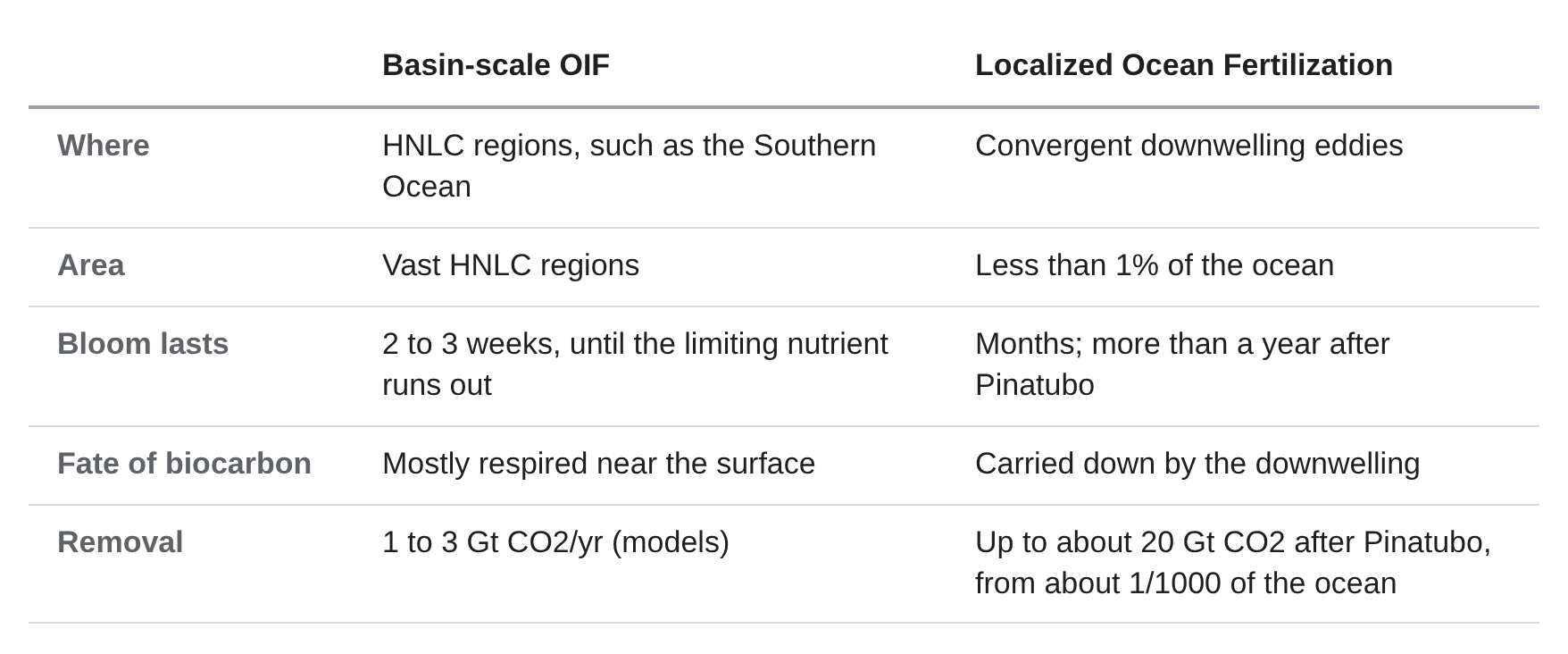
If you work on ocean iron fertilization, you know the arguments against it by heart. Models say iron fertilization spread across entire ocean basins, which the literature calls “basin-scale” OIF, could remove 1 to 3 Gt of CO2 a year at most. It would use the vast high-nutrient, low-chlorophyll (HNLC) regions of the ocean, where nutrients are plentiful but iron is scarce, at the risk of turning those waters into what some critics have called pea soup. Those concerns are widely discussed and well founded. They are also about a version of ocean fertilization that nature does not use and no one has proposed to implement.
Nature appears to use a different version: Localized Ocean Fertilization (LOF), confined to convergent downwelling eddies. That is our hypothesis, built from the data below, and our 2027 pilot is designed to test it. This piece explains how it works, the evidence for it, and how we can begin governing it.
Click here to show your support to allow climate-restoration solutions and governance for them.
Climate restoration: the goal behind the method
Climate restoration means returning atmospheric CO2 to below 300 ppm by 2050, the range in which human civilization developed and thrived. It is climate justice between generations: giving our children the safe climate we were given. Today CO2 is above 420 ppm.
Cutting emissions remains essential, but it only slows the rise. Even net-zero would hold CO2 near today’s level, along with today’s heat waves, fires and ocean acidification. Giving our children a safe climate requires removing the excess CO2 already in the air, roughly 1,000 Gt.
To do that by 2050 we need net removal of about 60 Gt of CO2 per year. Current carbon capture machinery operating at hundreds of dollars a ton cannot reach that scale at an affordable cost. A natural process that already operates at that scale can. So far, we know of one.
LOF: iron fertilization where it works
LOF is “localized” iron fertilization: iron enters convergent downwelling eddies, naturally or by design. These rotating ocean currents, typically 100 to 350 km across, supply two important things that open-ocean fertilization lacks:
Fast export. The downwelling current carries phytoplankton biocarbon down before grazers can eat it and respire the CO2 back to the air.
A bloom that sustains itself. The converging flow holds iron at high levels for months, long enough for nitrogen-fixing cyanobacteria such as Trichodesmium to multiply. Their colonies store the iron and stay near the surface, keeping it in the sunlit layer instead of letting it sink away. They supply the nitrate that iron-triggered blooms usually exhaust within two or three weeks.
Iron experiments have generally run into both limits: the bloom ends when the limiting nutrient runs out, and most of its carbon is respired near the surface, rapidly returning to the atmosphere. LOF addresses both.
Eddies are a bit like donuts. A downwelling eddy has some upwelling around its rim, and an upwelling eddy has some downwelling around its edge. The EIFEX OIF experiment in 2004 showed rapid deep export from an iron-induced bloom inside a coherent eddy. How eddy structure shapes export is still barely studied, and our pilot is designed partly to measure it.
The evidence: three eruptions out of ten
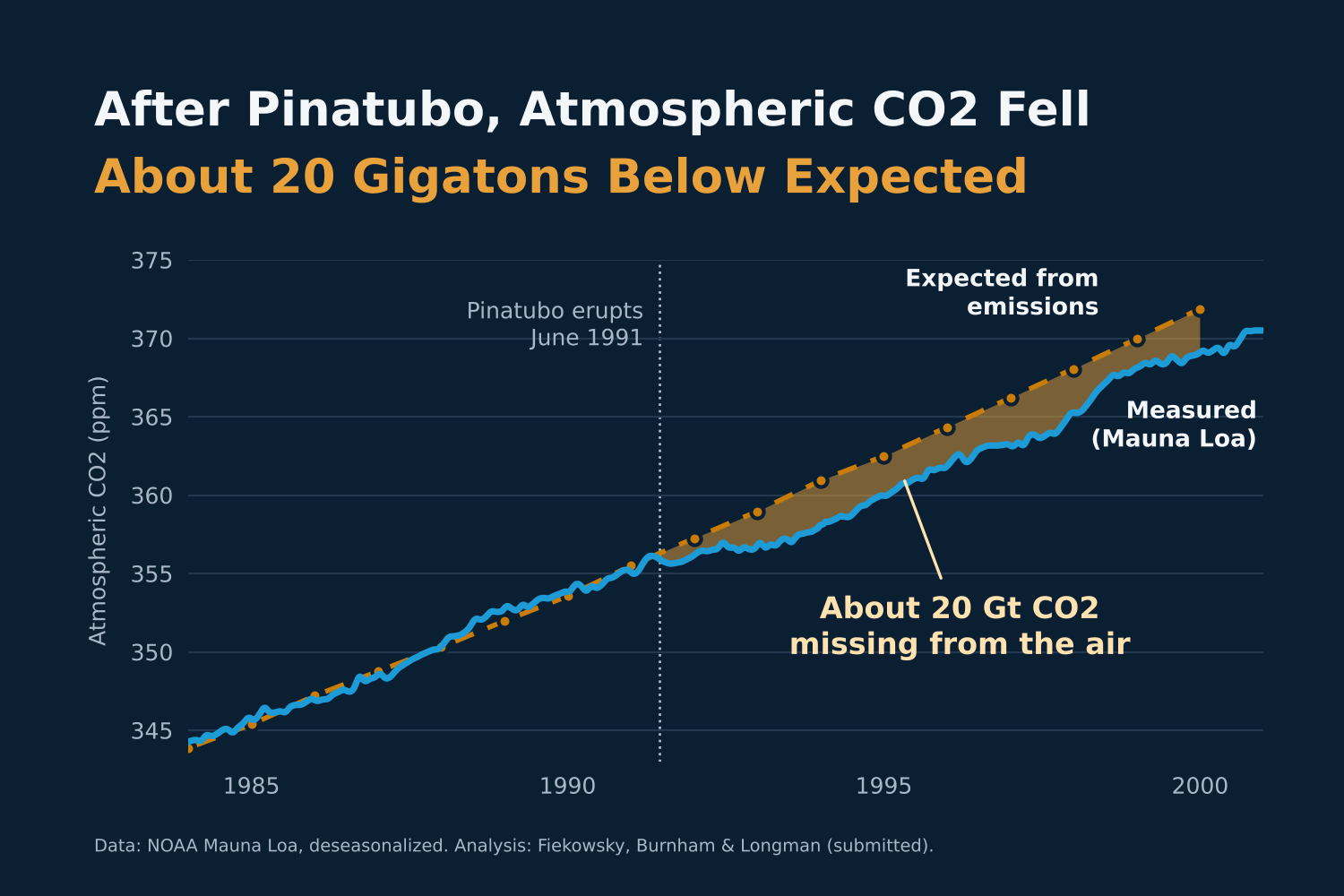
Mount Pinatubo erupted in June 1991 with most of its ash falling on the South China Sea. For almost two years afterward the Keeling curve shows CO2 stayed nearly flat, although humanity was emitting more than 20 Gt of CO2 a year. About 20 Gt of CO2 was removed. More than three decades later, CO2 remains about 2.5 ppm below where it would otherwise be. The removal has lasted.
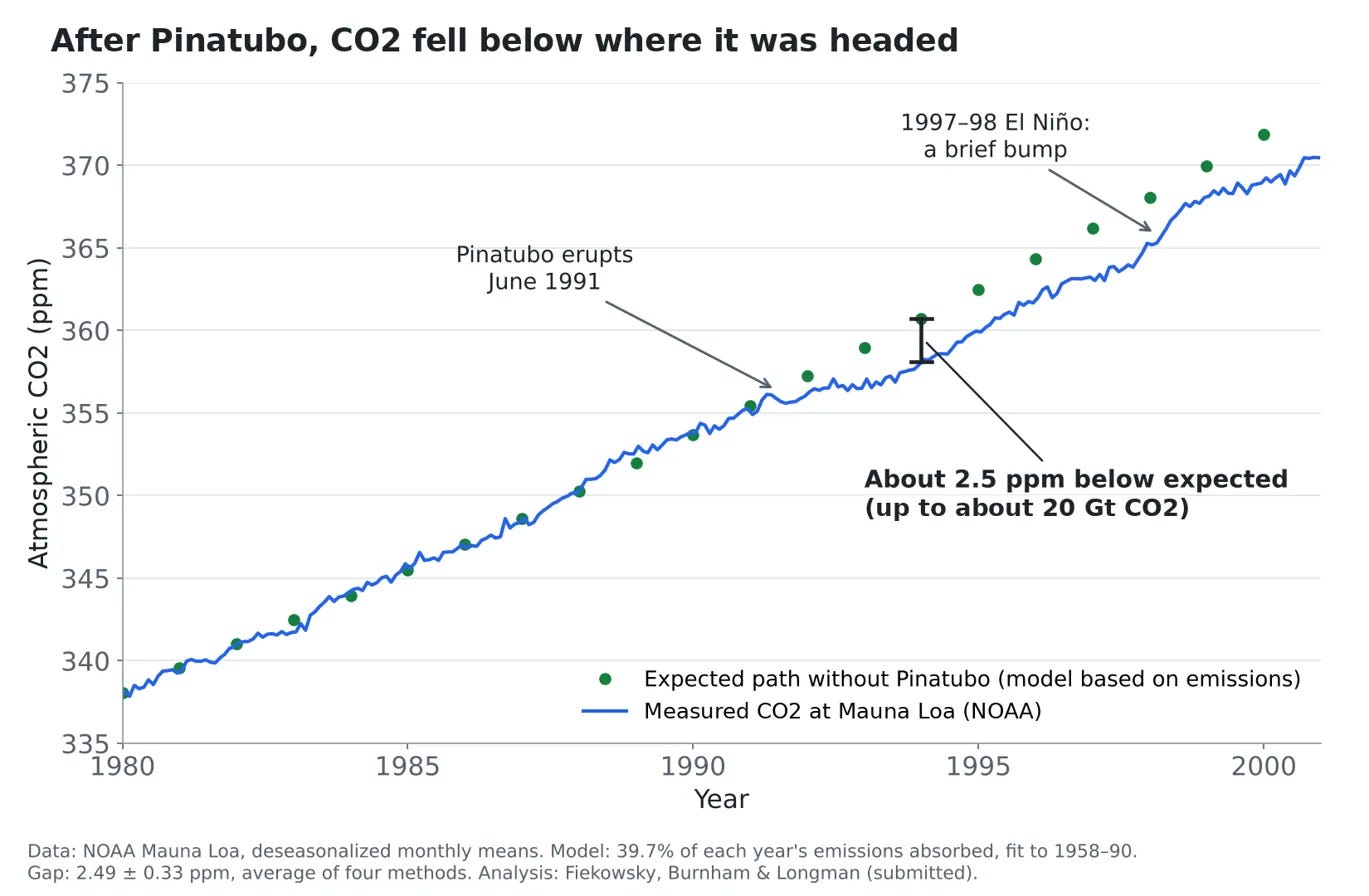
After the 1991 Pinatubo eruption, atmospheric CO2 fell about 2.5 ppm below the path expected from emissions, and stayed there. The 1997–98 El Niño bump, by contrast, reversed within a year or two. Data: NOAA Mauna Loa. Analysis: Fiekowsky, Burnham and Longman (submitted).
Our forthcoming paper with Alan Burnham and Jack Longman puts Pinatubo in the context of a 500-year geological record. Since 1500, ten eruptions were large enough to cool the planet. It appears that durable CO2 reductions were not from cooling. Only three were followed by lasting drawdowns of CO2:
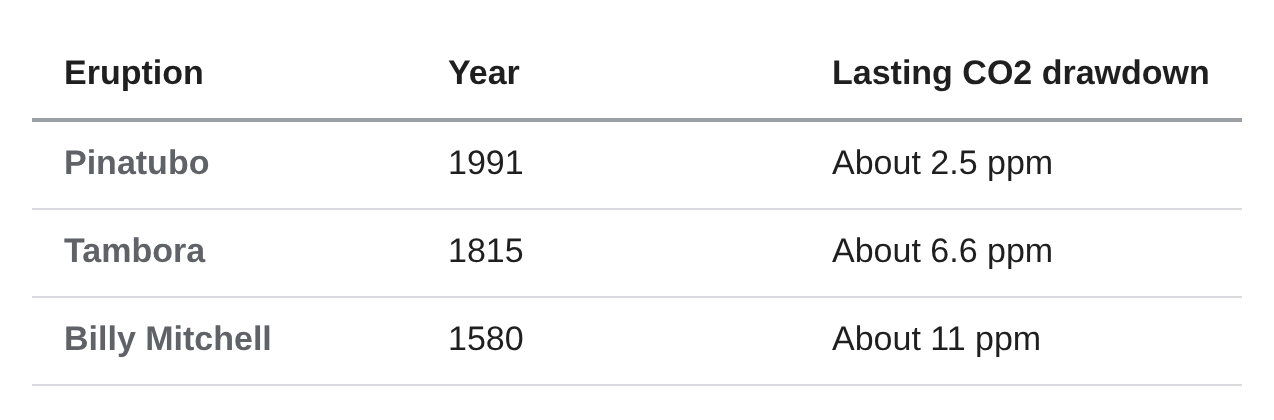
All three dropped their ash into seas where eddies are common. The other seven, including Krakatoa, Agung and El Chichón, dropped theirs mostly on land, in waters without strong eddies, or as nutrient-poor ash.
Any explanation of CO2 removal after large eruptions needs to pass two tests:
Selectivity: why did three cooling eruptions remove CO2 while seven did not?
Durability: why did the CO2 removal last for decades, instead of reversing like temperature-driven swings such as El Niño?
Increased land uptake, reduced soil respiration and plant growth under diffuse light all depend on cooling, so they fail the first test. To our knowledge, LOF is the only proposed mechanism that passes both. Pinatubo is consistent with LOF and, so far, with no other mechanism. That makes LOF worth testing directly, which is what our pilot does.
How LOF works
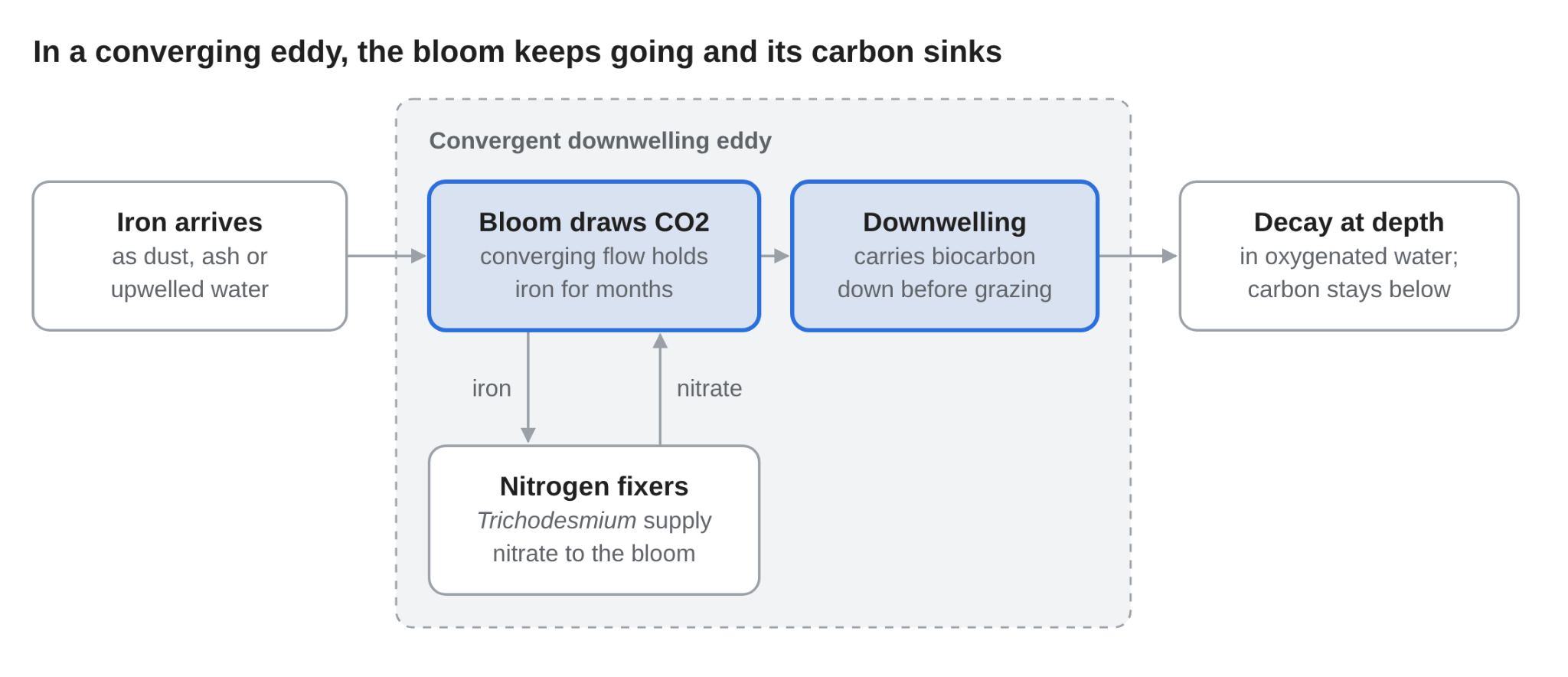
Two features distinguish LOF from OIF.
Iron triggers the bloom, as in any OIF. The eddy then does two things: its converging flow keeps iron high long enough for nitrogen fixers to feed the bloom, and its downwelling carries the biocarbon down to decompose in oxygenated water below the surface layer.
Why LOF is safer than OIF
Nature has fertilized the oceans with iron for millions of years, with carbon sequestration occurring in times and places where dust or ash fell on the right eddy. Marine ecosystems are therefore adapted to it. The three concerns raised most often about full-basin OIF look different when iron is contained inside a downwelling eddy. They appear to be largely eliminated.
Deoxygenation. Downwelling carries oxygen both from the atmosphere and from photosynthesis down with the biocarbon, so bacteria decompose the biocarbon in oxygenated water rather than extending the depth of deoxygenation. What we see from Pinatubo is consistent with this. Sediment cores from the ash-fall zone show no increase in organic carbon after the eruption, and diatom deposition actually fell. If a bloom removed some 20 Gt of CO2, nearly all of that biocarbon must have decomposed in the water column on the way down. That requires oxygen, which the downwelling supplies.
Nutrient robbing. Decomposition in water deeper than about 2.5 km releases the nutrients again within the downwelling water, and nitrogen fixers replace the nitrogen. Waters downstream in the depths are left with about what they had before.
Harmful algal blooms. The eddy converges, so the bloom and any toxins it produces, such as domoic acid from Pseudo-nitzschia, stay inside it and sink. LOF also takes place hundreds of kilometers offshore, far from the coastal waters where harmful blooms do their damage.
Too much iron. Someone new to the field asked a question no expert had: what is the worst that could happen if too much iron is added? Is there any amount of iron that could be toxic to the environment? The answer is: No.
Iron supports a bloom only until another nutrient, usually phosphate, runs out; beyond that, extra iron forms rust-like particles and sinks like dust. Up to that limit, more iron could produce a denser bloom, although well below the level of coastal blooms. Such a bloom would be expected to feed more fish, though few studies have tested this, because most blooms are short-lived. Thus an accidentally denser bloom hundreds of kilometers offshore would be expected to be self-limiting and beneficial to fish in that environment rather than a problem.
Why LOF is efficient
Pinatubo appears to have removed about 20 Gt of CO2 from an ash-fall area of roughly 1/1000 of the ocean. Modeling of basin-scale OIF gives 1 to 3 Gt a year from the vast HNLC regions. Downwelling eddies cover several percent of the ocean surface, tens of times the size of the Pinatubo patch, indicating that it is feasible for LOF to facilitate removals of 60 Gt a year. The cost follows from that. Iron is cheap and abundant, and LOF requires only small amounts delivered at the right times and places. We estimate that LOF at full scale would cost on the order of $1 billion a year.
For readers who know what OIF costs: we estimate LOF at 100 to 5,000 times cheaper per ton of CO2 than conventional OIF. More of the biocarbon reaches depth, the bloom sustains itself, and fast autonomous atmospheric measurement replaces most of the ship time that verification would otherwise need.
Innovative measurement methods produce most of the savings. In conventional OIF, verifying removal by ship costs on the order of $150 per ton of CO2, while the iron and its delivery cost only a few cents. Our low-cost autonomous sensor vehicles measure the CO2 leaving the air above the eddy instead of sampling a quarter million cubic km of shifting ocean. This streamlined approach cuts measurement costs by a factor of more than 1,000, to about half a cent per ton.
All in, LOF comes to about 2.5 cents per ton of CO2 removed (see appendix), well below the estimate the National Academies reported in 2022. We assume mostly autonomous boats disperse the iron.
Next step: the 2027 pilot, measuring LOF where nature already does it
Our pilot is designed to replicate the EIFEX experiment, letting nature itself supply the iron so we don’t have to. Each winter, gap winds blow from the Gulf of Mexico through the Isthmus of Tehuantepec. They drive coastal nutrient upwelling off southern Mexico while also spinning off large downwelling eddies, typically about six a year. Between October and May, these downwelling eddies drift westward for 2 to 8 months.
Their chlorophyll varies with the amount of iron upwelled near the coast. Because upwelling delivers iron-rich water in naturally varying amounts, it provides a natural experiment on how iron affects CO2 removal, without any intentional iron addition.
What we will measure:
CO2 removal over each eddy. We will use our newly developed Atmospheric CO2 Perimeter Flux (ACPF) method, published in Frontiers in Climate. A small fleet of self-positioning sensor buoys (autonomous surface vehicles, or ASVs) will be positioned around the eddy’s perimeter. Combined with satellite data on the height of the marine boundary (inversion) layer, they can measure CO2 removal in hours rather than weeks. Solar-powered, they can follow an eddy for months while traveling two thousand kilometers at no extra cost.
The bloom and its nitrogen fixers. Satellite data measure chlorophyll and blue-green algae. The blue-green signal tracks Trichodesmium, the cyanobacteria that we anticipate will keep the bloom going.
Where the carbon goes. For depth profiles, crew will drop sensors from the ship to measure oxygen and particulate organic carbon at various depths, both in and outside the eddy. As the biocarbon sinks, bacteria decompose it, using up oxygen. Thus the drop in oxygen, together with the remaining particles, indicates the amount of carbon that sinks.
In short, ACPF measures how much CO2 leaves the air, and depth profiles show where it went.
Success means three results:
CO2 removal tracks the bloom.
The bloom persists where nitrogen fixers are present.
The carbon reaches depth.
The hypothesis fails if CO2 removal does not track chlorophyll, or if the downwelling eddies show minimal downwelling.
Timeline
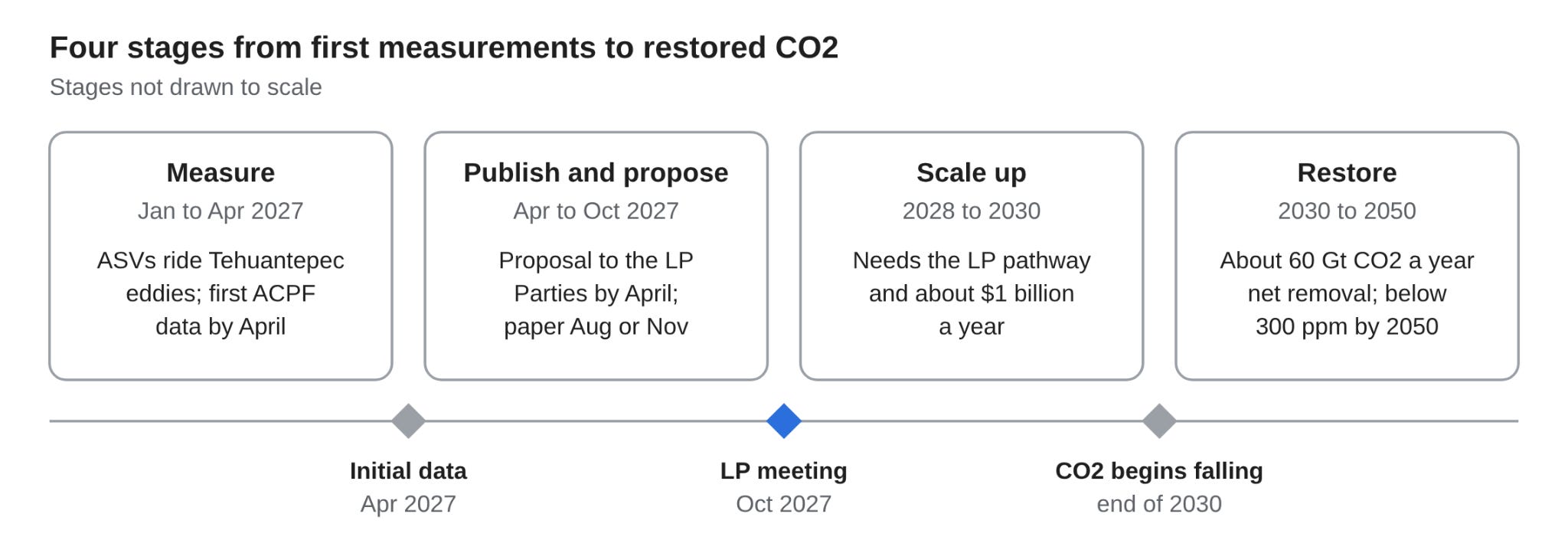
Four stages, three gates
The October 2027 London Protocol (LP) meeting is the gate that matters most: scale-up needs both a governed pathway and sanctioned funding of about $1 billion a year.
The real barrier is governance, not science
Under the London Protocol, ocean fertilization is allowed only as legitimate scientific research. The Protocol’s resolutions and its 2013 marine geoengineering amendment govern that research carefully. The 2013 amendment is not yet in force, but both the Convention and the Protocol have asked Parties to apply it provisionally, and some Parties have adopted national legislation to put it into effect. A new assessment framework for ocean fertilization research is now being finalized. The gap is that the framework has no path beyond research, however promising the results. Nothing leads from field research to potential deployment.
The consequences are serious. Restoring a safe climate in our lifetimes appears to require the ocean, and today there is no governed route to ocean CO2 removal at climate scale. Without such a route, even excellent research results have nowhere to go. Institutional funders will not yet discuss ocean fertilization, so our pilot is funded by individuals.
We are building a coalition to extend the London Protocol from governing research to governing climate-scale CO2 removal.
The LP Parties hold their next annual meeting in October 2027, and proposals must reach them six months prior. Therefore we are preparing a proposal for a Contracting Party to submit to the LP in April 2027. It will ask the Parties to extend the existing governed, monitored science pathway to include safe ocean CO2 removal at climate scale (safe being beneficial or non-damaging to the ocean ecosystem). Like every technology, LOF would grow step by step, from small field trials to larger demonstrations, each one informing the next. No engineer, oceanographer or chef goes from recipe to banquet without tasting along the way, and ocean CO2 removal is no exception.
Funders need to know that their projects have the acceptance of the global community. They may not need a final ruling to be comfortable, but they do need to see that a credible proposal is moving forward, and that respected people back it.
A future post will cover the governance case in detail from the perspective of climate justice: giving our children safe CO2 levels and climate.
Toward a governed path beyond research
To initiate the process of requesting an LP resolution, we are collecting signatures from individuals and groups who support expanding the LP’s purview.
We invite you to sign a simple statement showing your endorsement of the idea. It may be in your personal capacity, and will accompany an intended proposal to the London Protocol Parties in April 2027.
The statement simply relates that you support governance of ocean CO2 removal, not any particular method. Feel free to endorse this pathway whatever you think of LOF.
The London Protocol should provide a governed, monitored pathway beyond research for ocean CO2 removal that meets clear criteria for safety, impact and transparency. We call on the Contracting Parties to begin building that pathway in 2027.
Interested? Follow this link to endorse. You can sign as a technical expert or simply a supporter.
In addition, we are forming the Alliance for Governed Ocean Restoration Action (AGORA) to help set the proposal process in motion. Want to join AGORA and assist in preparing the proposal to the Parties? Please contact me directly through Substack or leave a comment below.
Later, as LOF pilot tests take place, there will be opportunities to join a panel to review data as it arrives. Skeptics are especially welcome.
This effort has no visible opponents except our own fear of change. Nature has shown us the LOF process three times in five centuries. In 2027 we can measure it, and begin governing it and other scalable approaches, together.
Sources
Fiekowsky, P. and Burnham, A. K. (2025). The Pinatubo CO2 pause suggests a rapidly testable path to multi-Gt mCDR. Preprint. doi:10.21203/rs.3.rs-6960838/v1
Fiekowsky, P., et al. (2026). Measuring large-scale mCDR using a novel Atmospheric CO2 Perimeter Flux (ACPF) method. Frontiers in Climate. doi:10.3389/fclim.2026.1941538
Fiekowsky, P., Burnham, A. K., and Longman, J. Linking volcanism and ocean eddy structure to episodic major CO2 capture events. Submitted to Frontiers in Climate.
National Academies of Sciences, Engineering, and Medicine. 2022. A Research Strategy for Ocean-based Carbon Dioxide Removal and Sequestration. doi:10.17226/26278
Sarmiento, J. L. (1993). Atmospheric CO2 stalled. Nature 365, 697–698. doi:10.1038/365697a0
Smetacek, V., et al. (2012). Deep carbon export from a Southern Ocean iron-fertilized diatom bloom. Nature 487, 313–319. doi:10.1038/nature11229
Appendix: The Cost of LOF per ton of CO2 removed
Operating costs are estimated conservatively below, to within an order of magnitude. Materials account for the bulk of expected costs.
Iron: Roughly $1000 / ton for iron (either particulate/dust, or dissolved iron sulfate). We assume that each ton of iron removes about 100,000 tons of CO2. This is within the range of CO2 / iron ratios of 8,000 to 1,000,000 commonly discussed, and consistent with the Pinatubo data. Thus the iron would cost about $0.01 / ton CO2 ($1000 per ton of iron divided by 100,000 tons of CO2 per ton of iron).
Shipping. A bulk iron carrier to transport 20,000 tons (capital and operating costs) would cost about $10M per year, per eddy. Each eddy needs about 20,000 tons of iron a year to remove 2 Gt of CO2, so that comes to $10M / 2,000 Mt CO2, or $0.005 per ton of CO2.
Distribution. Purpose-built autonomous distribution boats would cost roughly the same as shipping. It may require ten distribution boats per eddy each distributing about 5 to 6 tons of iron per day year-round (that is less than the weight of two cars) and costing $1M per year. That totals about $10M per year, per eddy, roughly the same as shipping cost, $0.005 per ton of CO2.
CO2 measurement using ACPF. The solar-powered, autonomous surface vehicles are quoted at about $100K / year each. Between 6 and 60 might be used per eddy, totalling less than $10M per eddy per year, also similar to shipping costs, $0.005 per ton of CO2.
Safety monitoring must be relevant to the intervention, which is the equivalent of the nutrient fertilization from a natural upwelling eddy. Ocean health is monitored first by chlorophyll density. Upwelling eddies commonly increase chlorophyll by a factor of ten, from typically 0.1 mg/m3 to 0.6 - 1.8 mg/m3. Intentional LOF would add iron to produce a similar chlorophyll impact in a downwelling eddy. This chlorophyll impact is already monitored globally by over 12 remote sensing satellite missions, fleets of biogeochemical Argo Floats and underwater gliders. The extra cost appears minimal, < $0.005 per ton of CO2.
Ultimately we might work with 10 to 50 downwelling eddies each year to remove 60 to 100 Gt CO2 / year to restore CO2 below 300 ppm by 2050. We assume that early in the learning curve each eddy might remove 20% of the annual rate removed after Mt. Pinatubo, or 2 Gt CO2 / year. As we learn more, intuitively we are likely to exceed the efficiency nature achieves by randomly “throwing dirt into the air” from eruptions and dust storms. If we match the Pinatubo numbers (>10 Gt CO2 / year), then we just need 10 eddies. The technology development promises to be fascinating.
Adding up the items above gives about $0.025 per ton of CO2, so removing 60 to 100 Gt a year to restore our planet’s climate would cost about $1.5 to 2.5 billion a year. We discuss a cost of $1 billion per year based on the Pinatubo data and a plausible assumption that using science can produce more efficient results than throwing a random distribution of rocks into the air at a random location. If technology fails to deliver for us, and we cannot come close to nature’s efficiency, a ten-fold increase in cost, to about $25 billion a year, is still a tiny blip: about 0.02% of the global economy.
I would love to assist in pushing the AGORA process forward in any way I can. As you mentioned, the real barrier to this potential intervention in ocean based CDR is governance and international collaboration. Getting the US onboard will also require some outreach and communication with leaders at all levels of society.
I am grateful to know that someone like you is seriously looking for a real solution to this existential threat. You’re a star!